Leading Like an Artist, Operating Like a Scientist: The Integration Problem in Education Leadership
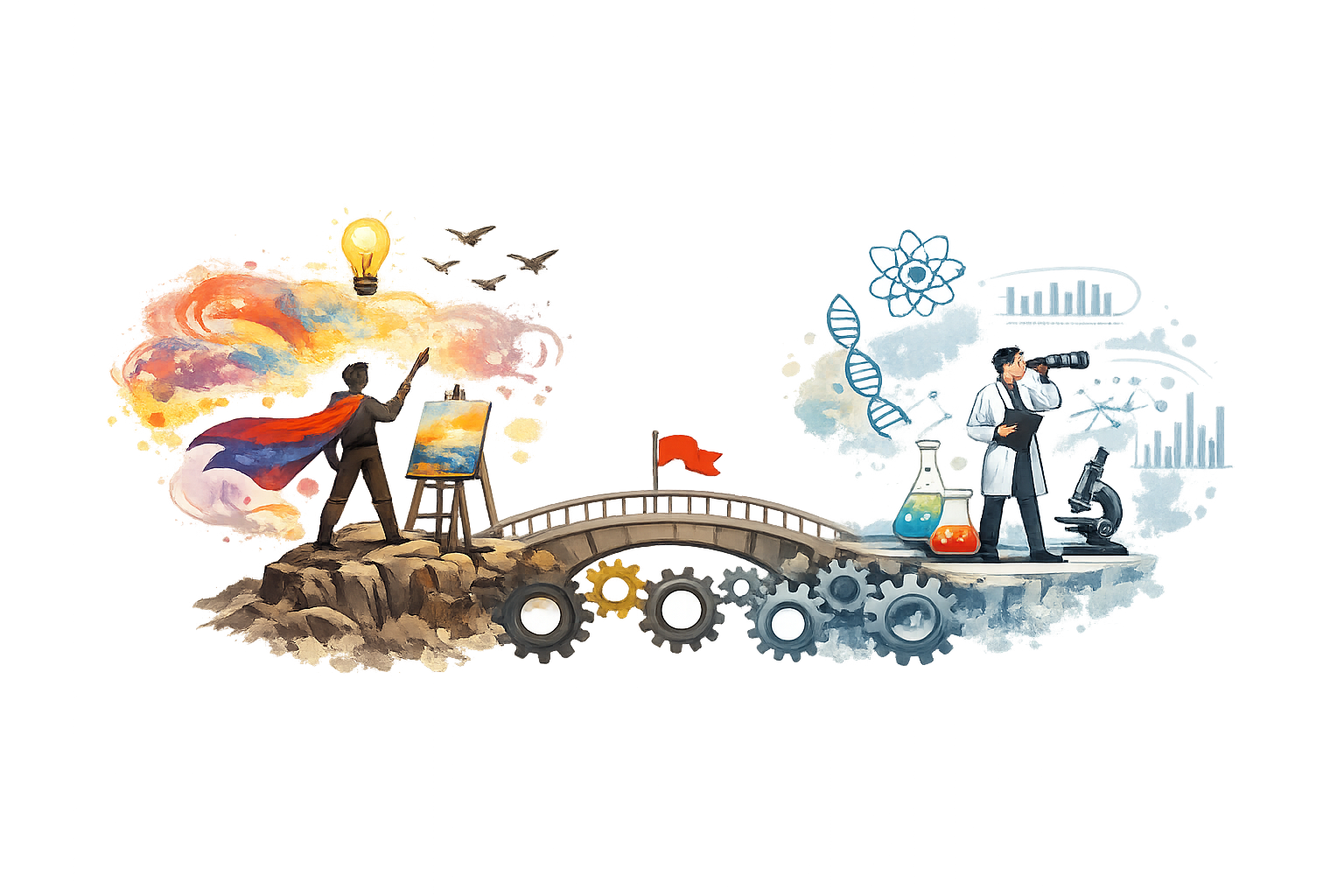
Brandon M. Calhoun frames a duality that anyone who has led a school will recognize immediately: the artist and the scientist. The artist sees patterns in chaos, tells stories that move people, and makes meaning visible. The scientist tests assumptions, measures impact, and builds systems that scale. But—as with hundreds of other leadership dichotomies—most leaders over-index on one.
Calhoun is right, but we want to go further on this because the problem in school leadership isn't just that presidents or heads of schools lean one way or the other. It's that our sector rewards the split and then wonders why integration is so rare.
The Artist Without the Scientist
We all know this leader. They cast a compelling vision. They give the speech at the opening faculty meetings that makes people cry. They can walk into a fractured community and name what is happening in a way that makes people feel seen. They often win the search sweepstakes because committees and boards love the vision thing.
But ask them about enrollment yield by segment and you get a pause. Ask them how they would evaluate whether the new curriculum map is actually improving student outcomes, and the conversation drifts back to a visionary narrative. The strategic plan reads beautifully and never translates to implementation.
This is sometimes a beloved head of school whose school is slowly drifting. Laurels are being rested upon, and the drift is invisible precisely because it is so gradual and the storytelling so good. A charismatic leader can describe decline as a transformation for longer than most boards realize.
The Scientist Without the Artist
This leader can explain the five-year attrition trend by division, the price elasticity of tuition by family income band, and the exact cost per square foot of the planned renovation. They develop dashboards. They restructure operations. They make the schedule work. They prioritize data, systems thinking, and technical competence over charisma or political maneuvering, often creating an environment where rational analysis outweighs intuition or tradition.
This style tends to produce highly efficient, methodical organizations that value precision and long‑term optimization. But they struggle to explain why any of it matters beyond operational success. Faculty meetings feel like quarterly earnings calls. The school's identity flattens into a series of performance indicators. Parents sense that the school has become efficient, but cannot articulate what it stands for against peers in the market.
At the same time, technocratic leadership can struggle when human dynamics, cultural nuance, or emotional intelligence are essential to progress, since its strength—expert‑driven objectivity—can inadvertently distance stakeholders who seek voice, values alignment, or relational connection.
Why Schools Make This Worse
Independent and international schools structurally intensify this dichotomy in ways that other organizations do not.
First, let's talk about the pipeline. Most school leaders start out in the classroom—building their careers on relational artistry and the daily creative act of teaching. The artist identity isn't just a preference; it's their professional origin story. We see this in the Myers-Briggs profiles of faculty. Moving into headship often means adopting new skills in operations, finance, and strategy—areas that weren't part of their initial training. Some handle this transition well, and these areas might even reveal their hidden strengths. Others do it reluctantly, viewing the technical side as a necessary evil rather than an equal part of their role.
Second, boards. Governing boards often hire based on vision and then fire for lack of technical implementation competence. We see boards gravitating toward what they saw as missing in the previous head of school. Had a visionary artist last time, but the daily operations were messy? Then find a leader who prioritizes data, systems thinking, and technical competence over
Third, the culture of schooling itself. Schools are meaning-making institutions that deal in identity, aspiration, and belonging. The language of school life is naturally artistic—full of stories, symbols, and relationships. This pulls toward the poetic side of Calhoun's spectrum and subtly questions the technocratic. A head who focuses too much on metrics risks being seen as losing the bigger picture (and maybe the faculty, too). A head who emphasizes mission too often risks losing sight of the operational details.
What Artist-Scientist Integration Actually Looks Like
Integration isn't about balance. It's not about spending half your time on vision and half on operations. It's about the ability to do both simultaneously—to view the enrollment data and interpret it as a story about who your school is becoming, to cast a vision and immediately ask how you'd know if it's succeeding. Read this again and notice how doing both at once is like juggling dangerous objects of vastly different weight and shape.
The integrated leader can translate a financial constraint into a strategic narrative. When the endowment draw needs to decrease, this isn't presented as a budget problem. It's framed as a question about institutional identity: What do we continue funding because it's who we are, and what do we reconsider just because we've always funded it? That is leadership artistry in service of operational discipline.
The integrated leader can critically examine their own best ideas. They propose the new program, the expanded initiative, or the bold partnership—and then ask the leadership team or cabinet to stress-test it against enrollment figures and student outcome impacts. They establish the evaluation framework before launch, not afterward. That's scientific thinking supporting visionary ambition.
The integrated leader shares stories backed by evidence and develops the narrative from proof. The annual report isn't just a collection of data. The strategic plan isn't a poem. Both are well-structured arguments that combine storytelling with measurement.
The Development Question
The issue with integration is that the artist and the scientist are often not the same person—or more accurately, the same person has not been asked to combine these skills until the stakes are already high. Since most leaders over-identify with one mode, and any strength overdone quickly becomes a weakness, the practical question is how one develops the other.
For the artist learning to be a scientist: start by asking "how would we know?" after each goal. Make it a habit to define success in detail before you begin, not afterward. Find a CFO or COO who doesn't just oversee operations but who can teach you to think operationally. Read your own financial statements until they become a storytelling language you're fluent in.
For the scientist learning to be an artist: start with the discipline of asking "what does this mean in terms of our mission?" after every data point. Spend time with your most gifted teachers—not to evaluate them, but to study how they make ideas come alive in a room. Practice speaking about your school in language that a prospective parent would repeat to their partner at dinner. A brand isn't a tagline. It's a story that other people tell about your school when you are not in the room.
The true superpower is in combining the artist and the scientist into a unified leadership approach. We often view growth as just filling gaps—if you're weak in finance, attend a seminar to learn it. But integration requires a different kind of effort. It's synthetic, meaning you need to hold two ways of thinking in productive tension, letting the artist and the scientist debate inside your mind until they produce something neither could create alone. The leaders creating institutions that will last beyond their time—who are making schools more resilient, more unique, and more deserving of the trust families place in them—are those who have learned to think in both ways at once.