Leveraging Mimetic Theory to Keep Your Enrollment Pipeline Full
[NOTE: This is the second of a two-part blog about how the psychological concepts of social proof and mimetic theory influence enrollment decisions for parents and students. Although related, they are distinct and play roles at different stages of the enrollment process. Enrolling a student at an independent school isn't just a rational choice; it’s also an identity decision shaped by social proof and mimesis. Understanding how these two factors work helps leaders see why culture, community, and reputation are not just "soft” assets—they are core strategic assets as well. The first post was about social proof, and this one is about mimesis.]
Mimetic theory, based on René Girard's work, suggests that human desire is not made independently but develops through imitation. We want things because others—particularly those we admire, identify with, or want to imitate—desire them. Desire is thus social, contagious, and often unconscious. Instead of choosing based on intrinsic qualities, people look to models that indicate what is worth wanting. This process influences everything from consumer choices to cultural norms, especially in decisions about identity, status, and long-term outcomes.
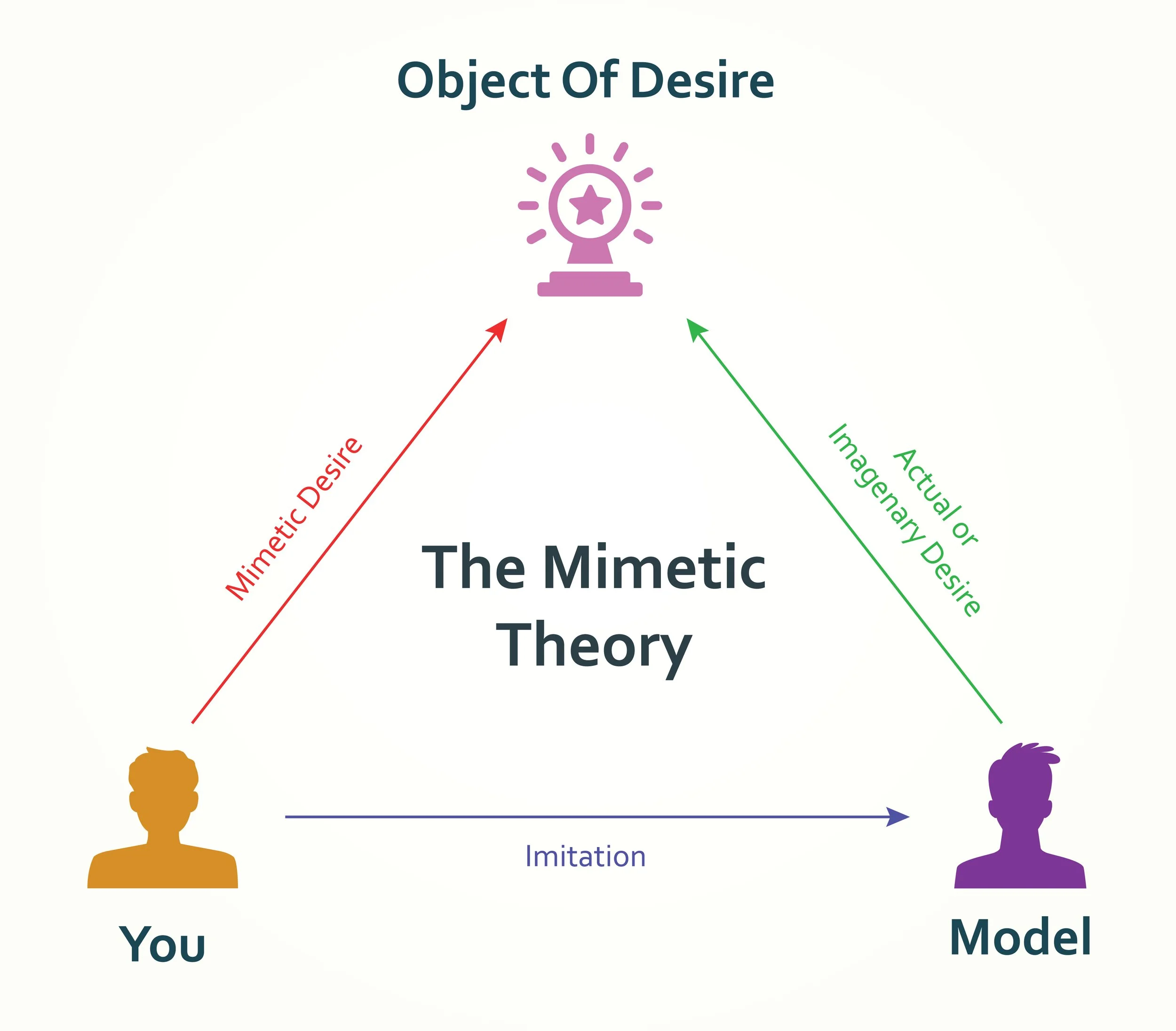
Independent school enrollment sits squarely in that territory. Families rarely start with a blank slate; they begin with an idea of “the kind of school people like us choose.” Before they attend an open house or read a mission statement, mimetic desire has already influenced their goals. They look to respected peers, communities they want to join, and families whose values they share. When those models desire a specific school—or a certain type of school—that desire spreads. Social proof later helps families justify and confirm their decision, but mimetic forces are what initially attract them. In this way, enrollment strategies are not just about sharing information or proving quality; they're about building a community and identity that families want to imitate and ultimately become part of.
Social proof, the topic of Part 1 in this two-part blog series, and mimesis are connected but distinct. The difference is subtle yet important — especially when considering how people make identity-driven decisions like choosing an independent school.
How Mimesis and Social Proof Differ
Social proof is a psychological mechanism that describes how people look to others’ behavior or opinions to decide what is correct, safe, or desirable.
It is about validation: “If others like me are doing this, it must be good.”
It is situational and often conscious.
Classic examples are customer reviews, testimonials, long waitlists, “most popular program,” and alumni success stories.
Social proof is essentially a heuristic — a shortcut for decision-making under uncertainty.
Mimesis (from René Girard’s theory) is a deeper cultural and psychological dynamic. It explains how people develop desires by mimicking the desires of others, not just their actions.
It is about wanting what others want, because they want it.
It is often unconscious and identity-forming in nature.
It shapes long-term aspirations, status competition, and rivalry.
Mimesis is not a shortcut; it’s a foundational mechanism of human desire and motivation. Mimesis and social proof overlap, but they operate at different psychological depths.
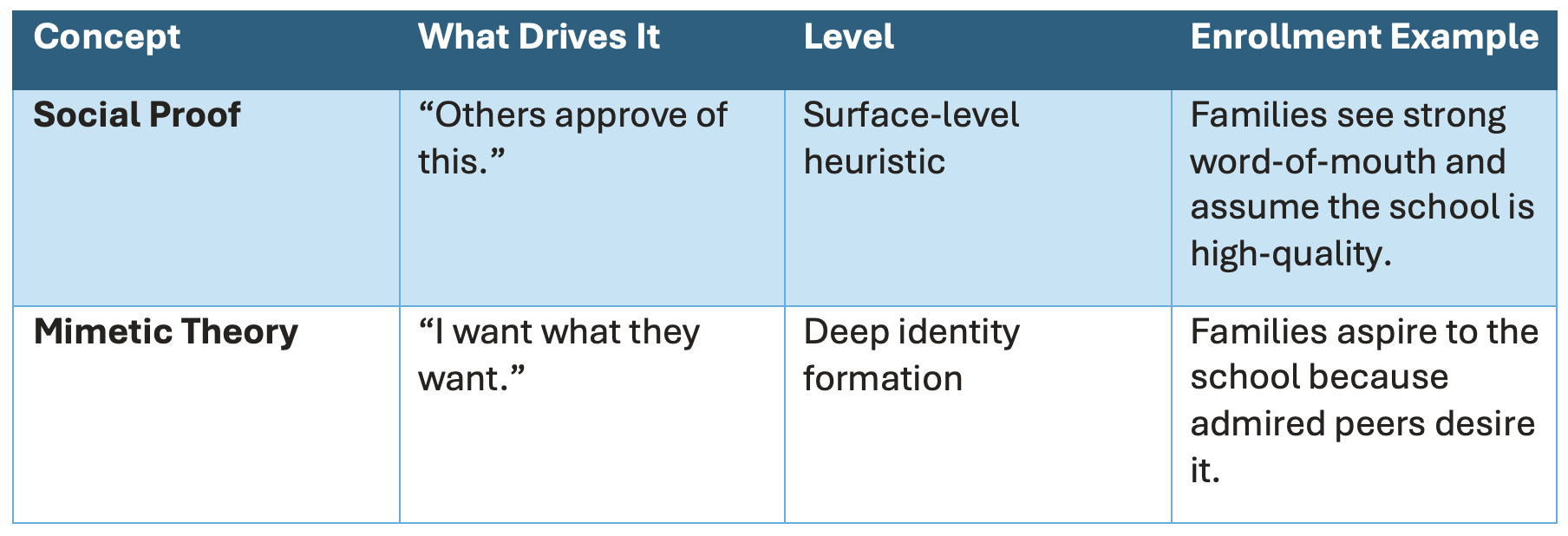
Social proof can trigger mimetic desire, but mimetic desire can also operate without explicit social proof.
This distinction is strategically useful for independent schools.
Social proof helps families feel confident about enrolling.
Mimesis shapes what families aspire to long before they inquire.
Schools that understand both can shape not just reputation, but desirability — which is a different, more powerful currency.
Social Proof and Mimesis as Strategic Levers
In Part 1, we said that independent school choice is not a purely rational process. Understanding and working with this fact is core to keeping the enrollment pipeline full and sealing the admission deal.
1. Social Proof: The Confidence Mechanism
Social proof is the reassurance families seek when making a high‑stakes decision.
It answers the question: “Do people like us trust this school?”
For trustees, this means:
Reputation is a risk‑management asset.
·Word‑of‑mouth is more powerful than any marketing spend.
Faculty, parents, and alumni are the school’s most credible validators.
Operational excellence (safety, communication, clarity) strengthens social proof.
Social proof helps families feel confident in the decision.
2. Mimesis: The Desire Engine
Mimesis shapes what families aspire to long before they inquire.
It answers the question: “Do we want to be part of the community that wants this school?”
For school leaders, this means:
Culture is a strategic differentiator.
The school’s identity must be coherent, legible, and lived.
Families are drawn to communities that reflect their values and aspirations.
Strategic clarity — who we are, what we stand for, and why it matters — fuels desirability.
Mimesis shapes the motivation to choose the school in the first place.
3. Why Leaders Should Care About Both
Social proof drives enrollment stability.
Mimesis drives enrollment demand.
Together, they create a self-reinforcing ecosystem of reputation and desirability.
When schools invest in culture, clarity of mission, faculty excellence, and community experience, they are not supporting “soft” initiatives. They are strengthening the psychological and social mechanisms that determine whether families want the school — and whether they feel confident choosing it.