
Not All Credentials Are Created Equal — And You Need to Know the Difference
It came up again a few hours ago during a strategic planning workshop for a large preK-12 school in the Southeastern U.S.: someone mentioned “credentials” and “badges” as areas the school should explore as added value for graduates. Credentials—a certification by the school that the student has completed a niche area of study or mastered a specific technical skill—are becoming a hot topic at almost every workshop we lead. Meanwhile, a quiet revolution is happening in the credentialing market, with significant impacts for independent schools—whether you are advising students on post-secondary paths, building faculty, or considering adding credentials to your programs.
New research from the Burning Glass Institute offers a sobering counterpoint to the credential hype: only 1 in 3 non-degree credentials actually helps earners move ahead. Nearly 70% lead to what the researchers bluntly call "dead ends"—little to no measurable wage gain or career mobility.
That's a statistic worth sitting with, especially as federal policy is about to expand Pell Grant eligibility to some short-term credential programs starting this July. More access is generally beneficial. However, having a credential that does not provide a good return may be worse than having no credential at all, especially for students who invest time and money expecting a payoff. The Burning Glass team doesn't say so explicitly, but one can sense faint echoes of the for-profit (and largely online) higher education craze from just a few years ago.
The Four-Category Framework
Burning Glass analyzed the career histories of about 40 million U.S. workers, of whom roughly 10 million hold a credential. They examined whether each credential helped workers accomplish one of three objectives: enter a new job, advance within a field, or earn more money. The results are plotted on a 2×2 matrix that every school counselor, faculty member, and trustee should understand (see below from the report).
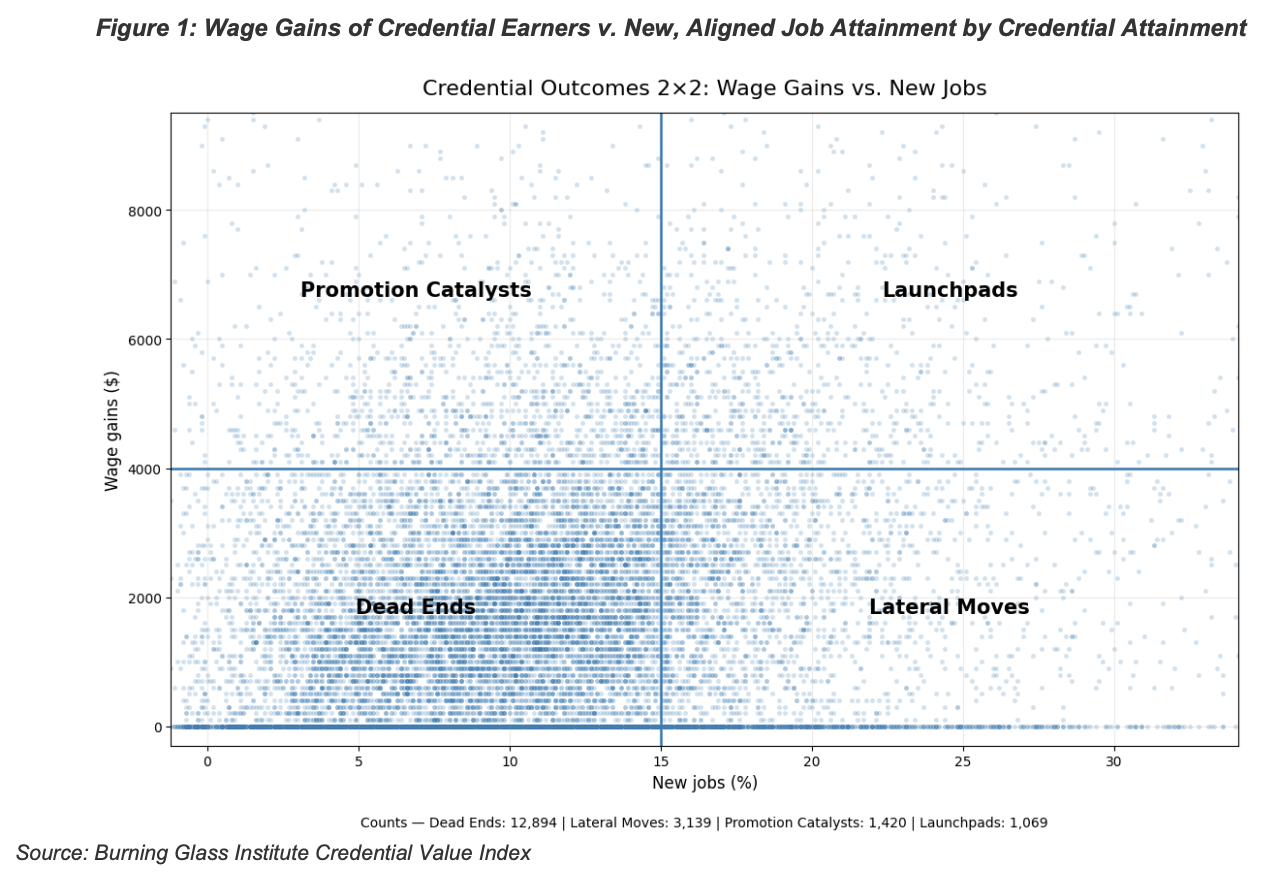
Launchpads (6% of credentials) help earners move into entirely new careers with wage increases of $4,000 or more. They serve as transformative—real on-ramps to new professional paths. Examples include licensed nursing credentials, certain AWS cloud certifications, and credentials in specific trades that have recognized industry value.
Promotion Catalysts (8% of credentials) do not necessarily alter what you do, but they help you advance within your field. A project management certification for someone already working in operations, or a leadership credential for a mid-career professional, can signal readiness for the next level even without changing sectors.
Lateral Moves (17% of credentials) are the most misunderstood category in the credential world. They may not lead to immediate wage increases, but they can help workers transition into better-fitting roles — a subtle yet genuine form of value. For instance, someone shifting within healthcare administration from, say, medical records to information systems, might not see a quick boost in pay, but they can gain access to work now and in the future that better fits them.
Dead-End Credentials (69% of credentials) show minimal measurable impact on wages or mobility. These may not be totally devoid of value—they may be emotionally fulfilling in some way—but as economic investments, they usually fall short. Many are issued by institutions that are more focused on enrollment revenue than on labor-market outcomes.
Rather than naming specific programs as “dead-end,” the research points to types that tend to land in this territory:
Workplace readiness credentials — Just over a quarter of all high school credentials only offer workplace skills like digital and financial literacy, instead of technical certificates for fields such as auto repair, construction, or welding. These typically lead to minimal wage growth.
Short, low-credit certificates — Returns to low-credit awards and certificates flattened and began to decline after seven years of completion, while longer credential programs held their value longer.
Badges and microcredentials — Between 2024 and 2025, individuals acquired badges and microcredentials at the fastest rate of any credential type, yet these are also among the least validated by employers. “Dime-a-dozen,” according to one HR professional.
Brand-name but job-irrelevant certifications — Certifications show patterns consistent with genuine skill-building, but these returns depend entirely on job relevance: irrelevant certifications deliver little to no return regardless of who issues them.
What This Means for Independent Schools
For college counselors and student advising: The surge in credentials is creating a new kind of decision for students and families — not just choosing which college, but also whether a shorter credential pathway might make more sense. This research provides a useful correction to the assumption that any credential is better than none. Counselors should assist students and families in asking more critical questions: Does this credential have employer recognition? Does it fall into the Launchpad or Promotion Catalyst category, or is it likely a Dead End? The Burning Glass Credential Value Index is now publicly available and searchable — it is worth bookmarking.
For heads of school and academic leaders: Many independent schools are exploring microcredentials as a way to differentiate their programs or add value for students. The temptation to add credentials for their own sake — to signal innovation — is real. The research suggests the more important question is whether those credentials carry labor market weight. Credentials embedded in majors or capstone experiences only create genuine value if employers actually recognize and reward them.
For boards overseeing strategic planning: As you evaluate new program investments, the credential landscape is a useful lens. Workforce alignment has become a central concern in independent school strategy, particularly at the secondary and post-secondary interface. Understanding which credential categories create genuine value — and which are largely credential theater — should inform how schools position themselves in an increasingly credential-saturated market.
For professional development: The same framework applies to faculty and staff credentialing. Schools regularly fund professional development credentials for faculty. Asking whether those credentials actually advance careers, increase effectiveness, or simply add lines to a resume is a legitimate governance and resource allocation question.
The Information Problem
The Burning Glass research also highlights a challenge that anyone trying to reform how families select colleges will recognize: data availability doesn't guarantee data usage.
The U.S. Department of Education's College Scorecard has been publicly available for over a decade. Usage remains, in the words of journalist Jeff Selingo, who brought this research to light, "anemic." The same pattern is likely to emerge with the Credential Value Index, a tool for assessing the economic and career value of a given credential. People do not make major life decisions by browsing outcome databases. They rely on familiarity, social proof, and recommendations from the institutions around them.
That is exactly why schools hold a uniquely influential role in this landscape. We are among the most trusted advisors for students and families. When we recommend a credential pathway — or include one in our programs — it carries considerable institutional weight. That presents an opportunity, but also a responsibility.
The right question is not "Are credentials valuable?" They can be. The real question is: which ones, for whom, and under what conditions? That's the kind of detailed guidance only a trusted school community can give — and it is another reason why the human relationships at the core of independent school education remain essential in an information-rich world.